
(index page)
Party with PIDapalooza (virtually) in 2021
PIDapalooza is going online in 2021!
We wish we could all be together in person for the fifth (!) festival of persistent identifiers, but we’re excited to bring the world’s largest—and longest—virtual PID party directly to your desk, your couch, your balcony—really, anywhere there’s a strong WiFi signal.

PIDapalooza 2021 will be a 24-hour nonstop PID party happening around the world. PIDapalooza has never been a regular conference and this one will be no different!
The party starts on January 27 at 14:30 UTC (see the time in your location here). Sessions will take place over the course of the following 24 hours. That’s right: we’re partying all night long and no matter your time zone, you’ll be able to join in.
Propose a session…and visit PIDapalooza.org for more details to about the program, the structure, and how to participate.
In the meantime:
- Mark your calendars!
- Think about a session to propose, any keynotes or program topics to suggest, and any co-located meetings you might want to hold that week. We’ll send out a call for proposals toward the end of September
- Add your favorite jam to the 2021 playlist!
- Keep on rockin’ the PIDs!
PIDapalooza 2021 is brought to you by the following PID groupies:
California Digital Library, Crossref, DataCite, NISO (welcome to our newest groupie!), and ORCID
For more information, visit the PIDapalooza website and follow PIDapalooza on Twitter.
PIDapalooza 2020: Highlights from the Fourth Festival of PIDs
Last month, PIDapalooza rocked the world again! The fourth festival of persistent identifiers, which took place in Lisbon, featured a Portuguese classical guitarist, a Japanese nail artist, an interpretive dance about the scientific process, several uses of beach balls, silly hats and bells, the latest version of the fabulous PIDapalooza playlist and, of course, the lighting of the eternal flame!
There it is, the eternal flame of persistence is turned on thanks to its supporters 🔥 #PIDapalooza2020 @ORCID_Org @datacite @CrossrefOrg @CalDigLib pic.twitter.com/1ZnaqbAZYe
— Mohammad Hosseini (@mhmd_hosseini) January 29, 2020
The festival lineup in Lisbon was impressive, with more than 40 different sessions from expert speakers who shared their PID successes and challenges, presented their visions for PID connections and PID communities, and introduced new PIDs on the block, all while discussing these serious topics in a range of interactive and engaging formats.
Not to mention the festival headliners: three inspiring keynote speakers…
First up was Maria Fernanda Rollo, Associate Professor at the Universidade Nova de Lisboa. Her talk, Towards the Circular Science: PIDs for a New Generation of Knowledge Creation and Management Paradigm in Portugal — from Vision to Reality, focused on her experience as Portugal’s former Secretary of State for Science, Technology, and Higher Education. As the person responsible for developing their national strategy for open science, Maria’s priority was more science, less bureaucracy — not as simple as it sounds! Democratization, efficiency, and transparency were key to the Portuguese PID policy, which included developing Estudante IDs for students and Ciencia IDs for everyone involved in science.
The second keynote, The Science Ecosystem and Open Science: A Multi-Legged Stool, was delivered by Beth Plale, program officer at the US National Science Foundation, working on open science, and a Professor in the Department of Intelligent Systems Engineering at Indiana University – Bloomington. Like Maria, Beth highlighted both the benefits and the challenges of open science, but her focus was primarily on data. She encouraged us to think about treating different kinds of digital content differently — for example, suggesting that not all data needs to be kept forever. And she noted that although “there’s a [PID] brain trust in this room,” most people don’t understand and/or care about identifiers; there’s a lot of work to be done on that front!
Last, but very definitely not least, was the closing keynote, Kathryn Kaiser, Assistant Professor and Scientist in the Office of Energetics at the University of Alabama – Birmingham. Her talk was entitled Dancing with the Scientists: The Costs of Piddling with Science without PIDs. In a festival-inspired mix of music, animation, and interpretive dance (yes, featuring a unicorn-themed beach ball), not to mention some memorable analogies — cheese as a metaphor for metadata, fishing as a metaphor for systematic reviews — Kathryn shared her pain, her struggles, her data, and her hopes as a researcher doing systematic review work in nutrition and obesity topics and relying on quality data infrastructure.
We are definitely all awake and energized after this fun start to @KatKaiserPhD’s keynote #PIDapalooza2020 😀 pic.twitter.com/SFw6A4nnQh
— PIDapalooza (@pidapalooza) January 30, 2020
#PIDapalooza2020 was the largest-ever gathering in the festival’s four years, with about 175 participants from around the globe, many attending for the first time.
And that’s a wrap! Farewell #PIDapalooza2020 & farewell Lisbon! Thanks to everyone for being such a great crowd – see you again for #PIDapalooza2021 in ….??? (But not Wyoming. Sorry Wyoming.) pic.twitter.com/0NIAbaLvCD
— PIDapalooza (@pidapalooza) January 30, 2020
When we asked festival attendees (*in a very scientific poll*) whether we had rocked their world this year, the answer was a resounding “Hell, yeah!”
We also asked you if #PIDapalooza2020 rocked your world. And yeah, hell yeah it did (apart from a handful of grumpy people)! pic.twitter.com/JAdcMu400l
— PIDapalooza (@pidapalooza) January 30, 2020
It is clear from attendee feedback that PIDapalooza is truly a unique event, bringing together a specialized community to discuss important topics in a friendly and inclusive setting. Some highlights from the 2020 festival in their words:
It was an incredibly positive and productive event! I appreciated the ability to connect with the leading experts in the PID community. It is a testament to the meeting that it draws a braintrust like this.
[I liked] That all keynote speakers were women! But also the rather “informal” approach (taking yourself not too seriously while taking the work seriously).
The range of parallel talks means that you can really tailor your conference experience. It can be totally different from the journey your colleagues and friends experience, and you can share what you have learned over delicious canapés in a rainy city!
There’s a wonderful community feel – everyone is interested in sharing, learning, and having conversations during breaks. It’s amazing to have the leading PID folks in one place!
This is the best meeting to attend for the work I do.
It will soon be time to start thinking about the next PIDapalooza — the fifth! We’re already thinking about using that important anniversary as an opportunity to experiment — with the format, the location, or both — as well as continuing to build on all the things people love about the event.
In the meantime, whether or not you were in Lisbon yourself, you can experience or revisit #PIDapalooza2020 on Twitter and through the presentations available on the PIDapalooza 2020 community page on Zenodo.
Post contributed by the PIDapalooza 2020 organizing committee: Ana Afonso (FCT), Helena Cousijn (DataCite), Maria Gould (CDL), Stephanie Harley (ORCID), Ginny Hendricks and Maria Sullivan (Crossref). Special thanks to Alice Meadows (NISO) for editorial support.
Persistent Identifier Services at CDL: A Rich Tapestry
EZID is one strand in a larger tapestry of persistent identifier activity at CDL. These activities, at their core, are focused on how and where persistent identifiers can help enrich and connect the scholarly outputs and cultural heritage materials of the University of California system. Persistent identifiers in this sense both drive and support CDL’s underlying mission to “provide[s] transformative digital library services, grounded in campus partnerships and extended through external collaborations, that amplify the impact of the libraries, scholarship, and resources of the University of California.”
The past year was a transitional one for EZID in particular and for CDL’s identifier services portfolio in general. In the first half of 2019, we completed a multi-year process to rescope EZID’s DOI services to focus exclusively on UC users. We worked to support non-UC users of our DOI services in setting up direct memberships with other providers through memberships with Crossref and DataCite. We also welcomed Rushiraj Nenuji to the development team as we said farewell to EZID’s long-time developer and original architect Greg Janée.
Last year, in the midst of these transitions, we posed the following question:
Rather than thinking about EZID solely as a tool or a service, we want to situate it instead as one layer of a deep and broad persistent identifier portfolio at CDL. EZID is a great tool for creating and managing DOIs and ARKs—what else could it do? And how might it also support infrastructure, training, and outreach for a more networked and interoperable scholarly communication ecosystem through the use and coordination of persistent identifiers?
Now, as we kick off the new year, we wanted to provide a brief update on what this persistent identifier services portfolio looks like, and how it will continue to evolve in the months ahead.
EZID remains involved in the day-to-day business of supporting DOI and ARK services for UC campuses as well as ARK services for non-UC EZID members. EZID development work is currently focused on strengthening and upgrading the application for long-term robustness and stability, and reconfiguring the platform to minimize dependencies on external systems. Future development work in the coming months will be geared toward optimizing the EZID user interface and adding more support for different metadata schemas.
From the portfolio perspective, we are working on a number of initiatives to encourage and enable the adoption and use of persistent identifiers across the UCs and beyond. A few examples:
We work closely with CDL’s eScholarship Publishing team to help UC journals obtain Crossref DOIs. An integration between eScholarship and EZID assigns DOIs automatically to eScholarship journal articles and sends the metadata to Crossref. These articles are then available to indexes, libraries, and other third parties, enhancing journals’ exposure and increasing the discoverability of their Open Access content. This service supports about 20 journals and our teams will expand to more publications in the year ahead. Two related efforts concern greater adoption of ARK identifiers for special collections objects (UCSF’s Industry Documents Library is one recent project), and DataCite DOIs for UC data repositories.
Organization identifiers are growing in visibility across the scholarly infrastructure landscape with the launch of the Research Organization Registry (ROR), of which CDL is a founding partner. The ROR registry now includes unique IDs for approximately 97,000 organizations, and these IDs are being supported in both DataCite and Crossref metadata. A number of platforms are integrating or looking to integrate ROR into their systems wherever affiliations are collected. The new Dryad platform was the first to pilot this type of ROR integration, and Dryad now has clean and consistent affiliation data for all of its datasets. With additional integrations expected in the new year, it will become increasingly easier for libraries and research administrators to track and analyze their institutions’ scholarly outputs.
Engaging with the broader PID community is another important aspect of our ongoing work. CDL is a member of the ORCID US Community, joining other institutions around the country in championing adoption and use of ORCID identifiers by UC researchers. We are also a founding sponsor of PIDapalooza, the festival of persistent identifiers now approaching its fourth year. We are collaborating within and beyond the UC in persistent identifier training and outreach, including providing guidance on identifiers for UC librarians, and organizing global workshops for stakeholders and practitioners.
All of these efforts showcase how persistent identifier services capture the spirit of the CDL’s vision as a “catalyst for deeply collaborative solutions providing a rich, intuitive and seamless environment for publishing, sharing and preserving our scholars’ increasingly diverse outputs.”
We are looking forward to the year ahead! As always, get in touch with your ideas and questions.
We’re Having a (PID) Party – And You’re Invited!
PIDapalooza 2020 is just around the corner (January 29-30, Lisbon, Portugal) — and it’s going to be fun! We have a great venue, the fabulous Belem Cultural Center, and a great lineup:
- On the main stage — three amazing keynotes: Maria Fernanda Rollo (NOVA FSCH), Beth Plale (NSF), and Kathryn Kaiser (University of Alabama, Birmingham). Plus a surprise local guest to help celebrate the start of the event!
- Throughout the event — more than 35 fast-paced sessions on a wide range of PID themes, from Achieving Persistence through Sustainability to PID Success Stories, and beyond
- Five PID Party sessions — 30-60 minutes of PID fun and games galore, led by the likes of ORCID, NISO, and TIB Hannover
- Our first-ever lightning talks — make sure you sign up on day 1 for your slot in this new one-hour session of rapid-fire, five-minute talks on the PID topic of your choice
- Not one, but two unmissable social events — a pay-your-own-way pre-meeting get-together at the TimeOut Market Lisbon on January 28, and the official PIDapalooza reception at 5:30pm on January 29 (venue to be announced soon).
- Plus all the usual fun you’ve come to expect from your favorite PID festival — the lighting of the eternal flame, your very own PIDapalooza T-shirt, the pub quiz, the wrap-up session, and more!
You can see the full lineup here, and tickets are now on sale (a bargain at just US$150!). Half of the available places are already filled (as of early December) — so get yours now!
Whether you’ll be attending PIDapalooza for the first or the fourth time — or if you’ve never attended — we’d also love to hear your thoughts about the event, so please take a few minutes to complete this short survey. We’ll share the results at PIDapalooza 2020, and on our blogs.
Thanks — and see you in January!
Your friendly neighborhood Planning Committee
Ana Afonso (FCT), Helena Cousijn (DataCite), Maria Gould (CDL), Stephanie Harley (ORCID), Ginny Hendricks and Maria Sullivan (Crossref)
Keep on ROR-ing: A Research Organization Registry Update
The Research Organization Registry (ROR) has had a big year! As CDL is a key partner in the ROR initiative, we are posting some updates here about what has been happening with ROR and where we’re going next.
The first prototype of the ROR registry launched in January and now includes unique IDs and metadata records for nearly 100,000 organizations. The registry’s launch marked the culmination of several years of planning and collaboration by numerous organizations and stakeholders from across the scholarly communications landscape to establish a guiding vision and a core set of requirements for open infrastructure for research organization IDs and metadata.
ROR emerged to fill a crucial gap in scholarly infrastructure: while we already had an open network of identifiers for research outputs (DOIs for publications and data) and research contributors (ORCID IDs), open identifiers for research organizations were a missing piece. With ROR we now have the power and the ability to connect and leverage all of these identifiers to enable better discovery and tracking of research outputs across institutions and funding bodies.
In addition to the registry itself, ROR offers open tools for interacting with ROR data and implementing ROR IDs, including a front-end search interface, an open API, a reconciler that works with OpenRefine to clean up messy lists of affiliations, affiliation matching functionality to connect free-text affiliation strings to ROR IDs, and a public data dump. All of the ROR code is available on Github. As we grow the registry, we will be building curation tools for maintaining ROR records over time, establishing a community curation board, and developing more support for system integrations and for usage of registry data.
ROR IDs can be captured now in systems and platforms where researcher affiliations are collected, and supported in Crossref and DataCite metadata. A number of ROR integrations are active or in progress, spanning data repositories, manuscript tracking systems, grant application systems, institutional repositories, and others. One of these early implementations—a simple affiliation lookup in Dryad’s data publishing platform that collects clean and consistent affiliation data for each dataset submitted—is described in this blog post.
ROR is run as a community collaboration and led by academic and nonprofit organizations with deep expertise in scholarly communication and open infrastructure initiatives. All of ROR’s work so far has been completed through in-kind donations from its steering organizations. We also have supporters and advisors from across industries and around the world.
In the coming years, we want to further develop ROR to enable greater adoption and downstream uses. Our organizations are committed to ROR for the long-term but we can’t move forward without additional community support. We have launched a fundraising campaign in order to be able to scale up our operations, hire dedicated staff, and develop and deliver new features, with a plan to launch a paid service tier in 2022 to recover costs while keeping the registry’s data open and free for all.
The ROR campaign’s first fundraising target is $75,000 by the end of 2019, and we have raised $36,000 so far, bringing us nearly halfway to our year-end goal. We are grateful to the following supporters for getting the campaign off to a strong start:
- Altum
- American Physical Society
- American Psychological Association
- Association for Computing Machinery
- Center for Science and Technology Studies (CWTS), Leiden University
- Curtin University
- Dryad
- eLife
- German National Library of Science and Technology (TIB)
ROR’s growing community of supporters speaks to the importance of building and sustaining open infrastructure for scholarly communications.
Steve Pinchotti, CEO of Altum—which has integrated ROR IDs into 26,000 institution profiles in its ProposalCentral grants platform—stated:
“ROR is a critical component of a connected research data landscape. As a software company focused on the advancement of research, Altum recognizes our responsibility to financially support and sustain the key research infrastructure initiatives like ORCID and ROR that enable open science and open global identifiers for research outputs, research contributors, and research institutions.”
Melissa Harrison, Head of Production Operations at eLife, adds:
“The distribution of high-quality metadata using various persistent identifiers is a great tool for advancing connections and the interlinking of scholarly content with other aspects of the ecosystem. We are delighted to support this community-led initiative for an open persistent identifier for research organizations to complement those we at eLife already use for content, peer review, data, people and funding.”
As we approach the end of the year, we are calling on our community to help ensure we will reach our goal. Contributions in any amount are welcome, and will go directly to support the registry’s growth and development. To start your contribution, email donate@ror.org to make a pledge and request an invoice. There are other ways to contribute as well—by spreading the word about the campaign, by implementing and adopting ROR IDs, and by telling others why open scholarly communications infrastructure matters to you.
Thank you for supporting ROR!
We’ll be rocking your world again at PIDapalooza 2020

The official countdown to PIDapalooza 2020 begins here! It’s 162 days to go till our flame-lighting opening ceremony at the fabulous Belém Cultural Center in Lisbon, Portugal. Your friendly neighborhood PIDapalooza Planning Committee—Helena Cousijn (DataCite), Maria Gould (CDL), Stephanie Harley (ORCID), Ginny Hendricks (Crossref), and Alice Meadows (ORCID)—are already hard at work making sure it’s the best one so far!
We have a shiny new website, with loads more information than before, including Spotify playlists (please add your PID songs to the 2020 one, an Instagram photo gallery, and of course registration information. Look out for updates there and on Twitter.
And, led by Helena, the Program Committee is starting its search for sessions that meet PIDapalooza’s goals of being PID-focused, fun, informative, and interactive. If you’ve a PID story to share, a PID practice to recommend, or a PID technology to launch, the Committee wants to hear from you. Please send them your ideas, using this form, by September 27. We aim to finalize the program by late October/early November.
Don’t forget to tie your proposal into one of the six festival themes:
Theme 1: Putting Principles into Practice
FAIR, Plan S, the 4 Cs; principles are everywhere. Do you have examples of how PIDs helped you put principles into practice? We’d love to hear your story!
Theme 2: PID Communities
We believe PIDs don’t work without community around them. We would like to hear from you about best practice among PID communities so we can learn from each other and spread the word even further!
Theme 3: PID Success Stories
We already know PIDs are great, but which strategies worked? Share your victories! Which strategies failed? Let’s turn these into success stories together!
Theme 4: Achieving Persistence through Sustainability
Persistence is a key part of PIDs, but there can’t be persistence without sustainability. Do you want to share how you sustain your PIDs or how PIDs help you with sustainability?
Theme 6: PID Party!
You don’t just learn about PIDs through Powerpoints. What about games? Interpretive dance? Get creative and let us know what kind of activity you’d like to organize at PIDapalooza this year!
PIDapalooza: the essentials
What? PIDapalooza 2020 – the open festival of persistent identifiers
When? 29-30 January 2020 (kickoff party the evening of January 28)
Where? Belém Cultural Center, Lisbon, Portugal (map)
Why? To think, talk, live persistent identifiers for two whole days with your fellow PID people, experts, and newcomers alike!
We hope you’re as excited about PIDapalooza 2020 as we are and we look forward to seeing you in Lisbon.
Cross-posted from the Crossref, DataCite, and ORCID blogs
ROR-ing Together: Implementing Organization IDs in Dryad
Co-authored by Maria Gould and Daniella Lowenberg and cross-posted from the ROR blog
How many datasets have been published in Dryad from researchers at the University of California? This question is surprisingly complicated. A short answer might be, we don’t know! A better answer could be, coming soon – stay tuned!
And a more complete and detailed answer might go something like this:
It’s not easy to determine how many datasets in Dryad are affiliated with the University of California – or any other institution, for that matter. This is the result of two main factors: (1) Dryad historically did not collect affiliation information from authors submitting datasets; and (2) even if Dryad had collected this information, it likely would have done so in a free-text field that allowed authors to write their affiliation in any number of ways (think “UC Berkeley,” “University of California-Berkeley,” or “Berkeley,” for example). Why? Because until recently, the scholarly research and publishing community did not have an easy and open option to rely on a standard set of affiliation names and related IDs to identify and disambiguate institutions.
This changed a few months ago with the launch of ROR – the Research Organization Registry. ROR is a community-led project to develop an open, sustainable, usable, and unique identifier for every research organization in the world. The ROR MVR (minimum viable registry) launched in January 2019 and began assigning unique ROR IDs to more than 91,000 organizations.
At its core, ROR is focused on filling a very specific and crucially important gap in scholarly research and publishing infrastructure: information about the organizations affiliated with researchers and research outputs. The rise of DOIs to identify datasets and publications and ORCID IDs to identify researchers and contributors has facilitated more efficient discovery and tracking of research outputs. But without being able to identify where these outputs and authors are affiliated, this discovery and tracking can only go so far. At best, an immense amount of additional and manual work is involved in extracting this information to fill the gap. At worst? The gap never gets filled in. With ROR IDs, the idea is that both of these scenarios no longer happen. ROR is intended for use by the research community, for the purposes of increasing the use of organization identifiers in the community and enabling connections between organization records in various systems.
ROR and Dryad joined forces this spring to tackle two different yet related challenges. Following the launch of the MVR, ROR was interested in finding a partner to pilot a simple yet effective implementation of the ROR API. Dryad was interested in implementing a solution to the problem of missing affiliation data. As a longstanding community partner in data publishing and open infrastructure projects, the Dryad team was eager to be an early adopter of ROR and blaze the trail toward wider implementation and collection of ROR IDs across multiple systems and platforms.
Dryad’s developers working on the new Dryad platform (launching later this summer) quickly got to work creating an affiliation field in the dataset submission form that calls the ROR API. When an author starts typing an affiliation, the field lookup searches for a matching name in ROR and shows the author a dropdown list of possible matches to choose from.
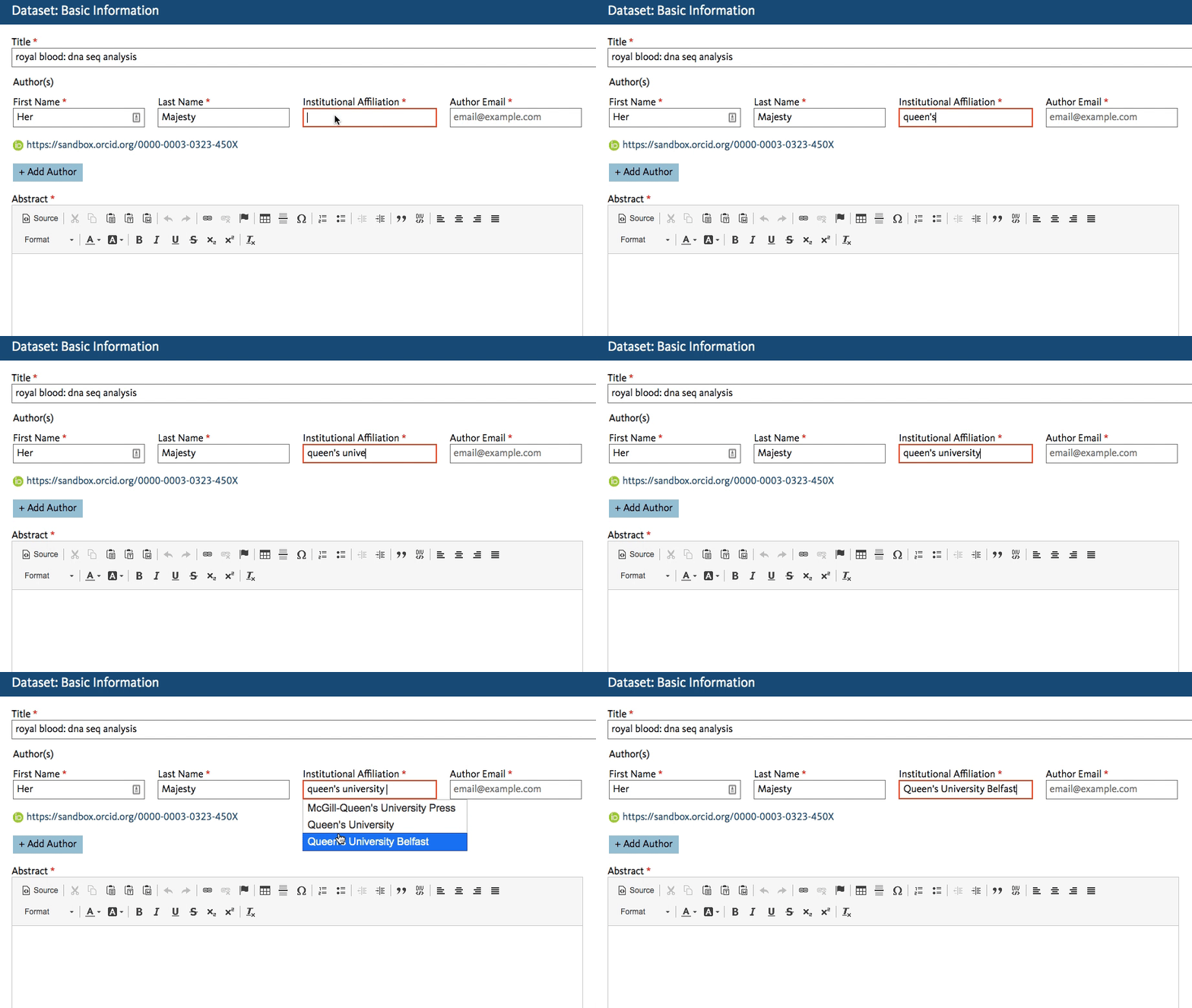
This will work regardless of whether the author starts entering a known abbreviation or the full name of the organization, as shown below.
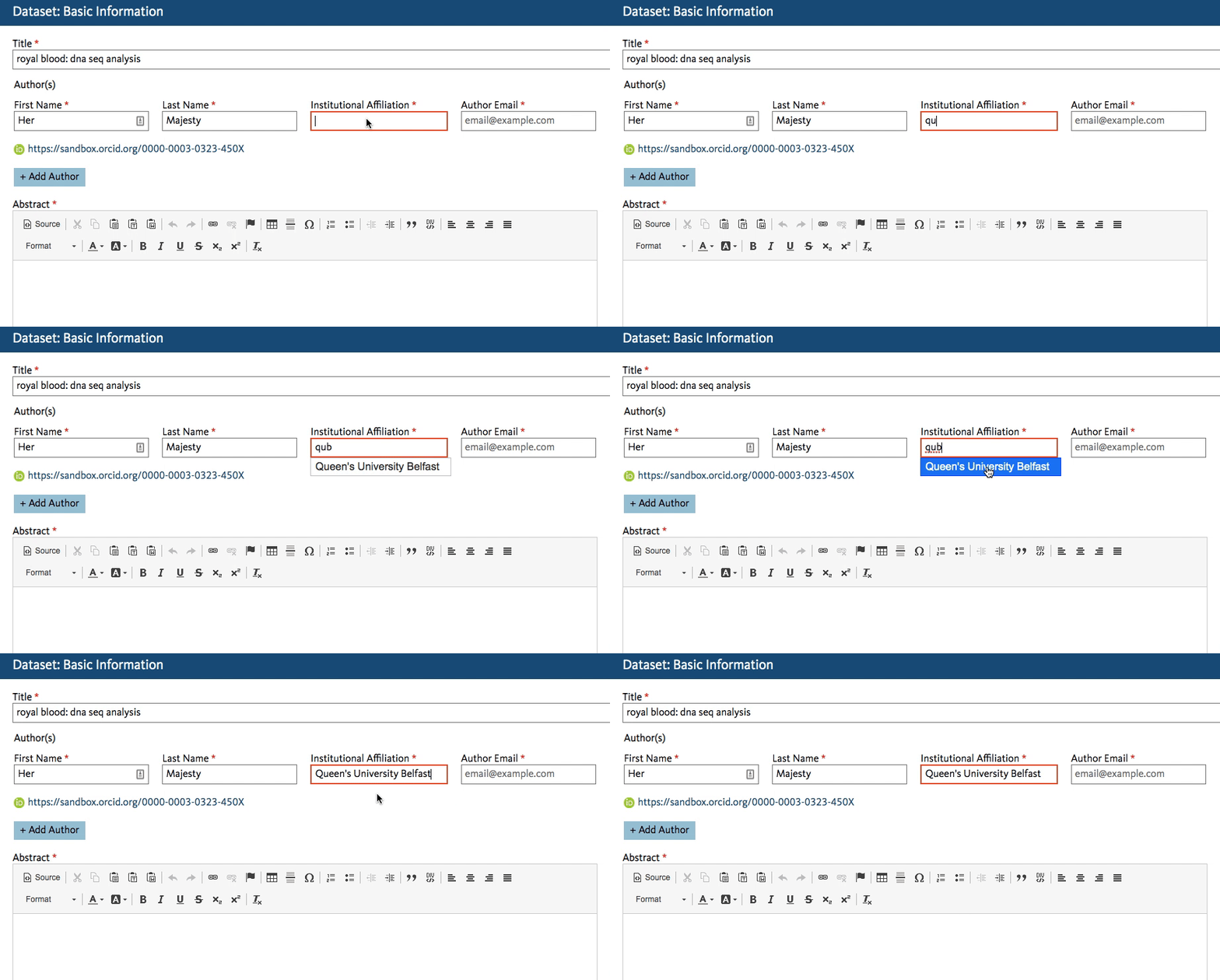
The author chooses the match and proceeds with the submission. The ROR ID is stored in the database – the author doesn’t even have to know it exists!
At this point you are probably curious about a few things: Can users override the matching and type whatever they want? What happens if a user’s affiliation is not found in the lookup? And how easy is it to implement this super-cool functionality in my platform?
We’ll address these questions in order:
Can users override the matching? Yes, the system will not prevent them from typing in an affiliation instead of choosing from the list. This is necessary to ensure a smooth submission process and also to allow for rare cases in which the user’s affiliation is not easily found in the lookup. In both of these situations, this is where Dryad’s curation workflow comes into play. A team of curators who go through each data submission will note if the affiliation is not a ROR ID, alter it if there is an existing one, or flag it for the ROR team to investigate and add to their corpus.
Now, how easy is it to implement this functionality in other systems? You can do it right now! Dryad’s code base is open-source and the team is happy to walk you through the implementation of ROR look up and autofill. To discuss the implementation you can get in touch here.
DataCite’s DOI registration system, known as Fabrica, already includes a similar lookup so this is a useful implementation to reference as an example as well.
With the ROR affiliation lookup implemented in Dryad, the future looks bright when it comes to the challenge of identifying research outputs by institution, as every new dataset submitted to Dryad will be associated with a ROR ID. But what about the datasets that are already in Dryad? As you’ll recall from the beginning of our story, affiliation details were not previously collected in Dryad at the time these datasets were submitted. This gap represents the work of approximately 90,000 researchers over the past ten years. The Dryad team wanted to ensure that these datasets had ROR IDs as well, so they teamed up with Ted Habermann (Metadata Game Changers) to identify those missing affiliations. By pulling from open APIs (Crossref, PLOS, Unpaywall, etc) and manually looking up affiliations from related articles, Ted is transforming a corpus of raw affiliations into standardized ROR IDs. Though it is a cumbersome project, this will ultimately allow for Dryad to have an entire database of ROR IDs for all past and future authors publishing their data.
The Dryad-ROR collaboration shows the promise and power of implementing organization IDs in publishing platforms to enable better tracking and discovery of research outputs by institution. We’re excited about this use of ROR and eager to see other platform providers pursue similar implementations in the coming months. Feel free to get in touch with your ideas and questions!
Passing the Torch of Persistence: EZID Development Update
Persistent identifiers are the backbone of scholarly communication infrastructure and long-term digital preservation, key to supporting a fully networked research ecosystem. CDL’s EZID service has been a leading example in the library and research community for how digital curation tools can enable and be enabled by persistent identifiers. The goal of the EZID service was to make the practice of creating and maintaining persistent identifiers, well, easy, and this remains the core feature of EZID to this day.
Achieving persistence with digital objects is a challenge even with a service like EZID. And sadly, achieving persistence with the people behind such services is its own challenge. This week, CDL officially bids farewell (following a transition we announced last year) to EZID’s lead developer, Greg Janée, who is moving on from the system he built ten years ago and has ably maintained over the past decade—a system known not only for making identifier management easy, but also for its reliability, robust API, impeccable documentation, and stellar uptime stats. As the digital curation landscape has been transformed over the years, with new organizations emerging in the identifier space, EZID has been a model of persistence in more ways than one, setting a standard to follow that will be part of Greg’s enduring legacy.
Fortunately for the UC system and for CDL, we will continue to benefit from Greg’s skills and knowledge as he assumes a new position as Director of the UC Santa Barbara Data Curation Program. We know Greg will bring his deep expertise to a broad range of research and preservation activities at UCSB, and we are looking forward to working with him through the networks and collaborations ongoing between UCSB and CDL.
And fortunately for EZID, Greg is passing the torch to another developer, who will be supporting EZID’s valuable services as we move into this new chapter. The EZID team is thrilled to welcome Rushiraj Nenuji, who joined us on May 1 and will be working as our software developer and technical lead.
Rushiraj is based in Santa Barbara and has a 50-50 split appointment between CDL and UCSB, where he is a Science Software Engineer at the National Center for Ecological Analysis and Synthesis (NCEAS). While he has been spending the last 2 months transitioning onto the EZID team, he is no stranger to UC3 as a past contributor to the Make Data Count project, which integrates with the Dash (soon to be Dryad) data publishing service. Rushiraj’s wide experience in front-end and API software engineering, informatics, and open scientific research infrastructure will be an asset for EZID as we pursue new directions and initiatives for the future of CDL’s identifier services portfolio.
Persistence and impermanence will always exist in tandem. And on this note, we bid farewell to Greg and extend a warm welcome to Rushiraj, who will continue the hard work of making identifiers easy and building on Greg’s efforts while exploring new directions for the future.
As always, if you have questions about EZID or about persistent identifiers in general, feel free to contact us at ezid@cdlib.org.
Hear Us ROR! Announcing Our First Prototype and Next Steps
What has hundreds of heads, 91,000 affiliations, and roars like a lion? If you guessed the Research Organization Registry community, you’d be absolutely right!
Last month was a big and busy one for the ROR project team: we released a working API and search interface for the registry, we held our first ROR community meeting, and we showcased the initial prototypes at PIDapalooza in Dublin.
We’re energized by the positive reception and response we’ve received and we wanted to take a moment to share information with the community. Here are the links to our latest work, a recap of everything that happened in Dublin, some of the next steps for the project, and how the community can continue to be involved.
🎉 Ta da! The first ROR prototype
The Research Organization Registry (ROR) is finally here! We’re thrilled to officially announce the launch of our ROR MVR (minimum viable registry). The MVR consists of the following components, which are ready for anyone to use right now.
- ROR IDs: Starting with seed data from GRID, ROR has begun assigning unique identifiers to approximately 91,000 organizations in its registry. ROR IDs include a random, unique, and opaque 9-character string and are expressed as URLs that resolve to the organization’s record. For instance, here is the ROR ID for California Digital Library: https://ror.org/03yrm5c26
- Search: We also built a search interface to look up organizations in the registry: https://ror.org/search.

- ROR records: ROR IDs are stored with additional metadata about the organization, such as alternate names/abbreviations, external URLs (e.g., an organization’s official website), and other identifiers, such as Wikidata, ISNI, and the Open Funder Registry. This metadata will allow ROR to be interoperable with other identifiers and across different systems. The current schema is based on GRID’s dataset and we plan to incorporate other metadata fields over time and according to community needs.

- API: The ROR API is now public. You can access the JSON files at https://api.ror.org/organizations.
- OpenRefine reconciler: We’ve released an OpenRefine reconciler that can map your internal identifiers to ROR identifiers: https://github.com/ror-community/ror-reconciler.
- Documentation: We have begun storing documentation on Github and will be adding more as we go along. Please feel free to follow and contribute: https://github.com/ror-community.
Community meeting recap
On January 22, 60+ representatives from across the research and publishing community gathered in Dublin to see what the ROR project team has been up to, demo the first prototypes in action, and discuss where we want to go next – and, of course, to practice ROR-ing together.

In the second half of the meeting, attendees split into discussion groups to identify specific aspirations for ROR and brainstorm concrete actions needed to achieve these goals, focusing on the main use case of exposing and capturing all research outputs of a given institution. The proposed ideas covered a spectrum of possibilities for ROR, highlighting the following themes:
ROR as seamlessly-integrated and sometimes invisible infrastructure
- Integration between and within existing systems (and in new ones!)
- Auto-detection of ROR IDs for example in manuscript tracking and funding application platforms
- As such, researchers don’t ever have to be responsible for knowing what a ROR is and using it appropriately – the systems they use will do this for them.
ROR as a critical piece of funder workflows and infrastructure
- Demonstrate to funders how ROR can help them analyze impact of research they fund
- Conduct outreach with key international funders, especially those interested in open infrastructure
- Make funders aware of ROR and encourage them to adopt and mandate use of ROR IDs – involve funders at the beginning to collaborate on technology
- Integrate ROR with existing systems and identifiers already in use by funders and other stakeholders
ROR as a trusted registry, collaborative partner, and responsible steward
- Culturally sensitive, inclusive, and respectful of what countries are already doing with regard to organizational identifiers, partnering with national bodies working on this and mapping ROR IDs to locally used identifiers.
- Involve the institutions listed in the registry early on as well as CRIS systems
- Interoperability with existing communities and governance bodies
- Workflows to support trust and responsible management of organizational metadata, with policies and procedures for long-term curation and maintenance of records
What we’re hearing
Now that the ROR MVR is here, we’re hearing some really good questions about the data we’re capturing, how it can be used, and how we’ll be maintaining the registry going forward. We wanted to take a moment to respond to some of these questions.
What is the criteria for being listed in ROR? What is a “research organization”?
We define the notion of “research organization” quite broadly as any organization that conducts, produces, manages, or touches research. This is in line with ROR’s stated scope, which is to address the affiliation use case and be able to identify which organizations are associated with which research outputs. We use “affiliation” to describe any formal relationship between a researcher and an organization associated with researchers, including but not limited to their employer, educator, funder, or scholarly society.
Will ROR map organizational hierarchies?
No – ROR is focused on being a top-level registry of organizations so we can address the fundamental affiliation use case, and provide a critical source of metadata that can interoperate with other institutional identifiers.
ROR IDs are cool – what can I do with them?
Now that we have built our MVR, we will be working to incorporate ROR IDs into relevant pieces of the scholarly communication infrastructure. If you are a publisher, funder, metadata provider, research office, or anyone else interested in capturing affiliations, please get in touch with us to discuss how we might coordinate. If you are a developer, you are welcome to start playing around with the API: https://api.ror.org/organizations.
There’s an error in my organization’s ROR record — can you fix it?
For the time being, please email info@ror.org to request an update to an existing record in ROR or request that a new record be added. We will formalize our data management policies and procedures in the next stage of the project.
What is ROR’s relationship to other organizational identifiers?
For ROR to be useful, it needs to augment the current offerings in a way that is open, trusted, complementary, and collaborative, and not intentionally competitive. We are committed to providing a service that the community finds helpful and not duplicative, and enables as many connections as possible between organization records across systems.
I have my own dataset of institutional affiliations — can I give it to ROR?
We are always happy to hear about other efforts to capture affiliation data. Please get in touch with us to discuss how we might coordinate.
Can ROR support multiple languages and character sets?
GRID already supports multiple languages and character sets, so by extension ROR will have this enabled as well. Here is one example: https://ror.org/01k4yrm29.
How will ROR handle curation, i.e., updating records if an organization changes its name or ceases to exist?
The curation and long-term management of records will be a cornerstone of our efforts in 2019 and we hope to release a working set of policies and procedures soon.
What’s next for ROR
Now that we have our MVR, what happens next for ROR? We’re eager to sustain the momentum from January’s stakeholder meeting at the same time we know there are some longer-term plans to put in place, and so we’re looking at both some immediate tasks as well as bigger-picture questions.
Product development
We have a few to-do items on our list following the launch of the MVR to keep everything running smoothly while we develop a comprehensive long-term product roadmap.
- Rewrite some of the code for both the API and the OpenRefine reconciler
- Address a few bugs in our repos
- Provide guidance for troubleshooting issues
- Communicate our processes for users to request changes, report bugs, and suggest features
As a reminder, you can access the existing code in Github: https://github.com/ror-community
Policy development
We’ve been emphasizing here and in community conversations that our primary focus now turns to formulating policies and procedures to ensure the successful management of ROR data over the long term. This is something we can’t (and shouldn’t) do on our own — we want to work with community stakeholders to develop the right solutions and establish the right frameworks. We understand the urgency of firming up these policies, but we are also aware that something this important can take time to complete and is not something to rush into lightly.
Community development
To help guide the next stages of the project, we are putting out an open call for participation in the ROR community advisory group. Advisory group members will be involved in giving input on data management, testing out new features, giving feedback on the product roadmap, and discussing ideas for events and outreach. We plan to convene this advisory group through bimonthly calls and asynchronous communication channels through the end of the year. We hope you will consider joining us! Please email info@ror.org if you are interested.
For those who want to stay informed about the project but not necessarily be part of the advisory group, you have other options!
- Sign up for our mailing list (via the footer at ror.org)
- Join our community on Slack (www.tinyurl.com/ror-community),
- Follow us on Twitter (@ResearchOrgs).
You can also always drop us a line at info@ror.org, and let us know if you’d ever like to set up a meeting or conference call to talk about the project in more detail.
Final thoughts
Community engagement has been vital to ROR’s beginnings and will likewise be critically important for the next steps that we take. As both a registry of identifiers and a community of stakeholders involved in building open scholarly infrastructure, ROR depends on guidance and involvement at multiple levels. Thank you for being part of the journey thus far, and for joining us on the road that lies ahead. 🦁
This has been cross-posted from the ROR blog
Where We Go From Here: An Update on EZID

Rather than thinking about EZID solely as a tool or a service, we want to situate it instead as one layer of a deep and broad persistent identifier portfolio at CDL. EZID is a great tool for creating and managing DOIs and ARKs—what else could it do?
For nearly a decade, California Digital Library’s EZID service has been the backbone of efforts to enable the open sharing, publication, and citation of research outputs through the use of persistent identifiers (PIDs) at all levels and layers of the scholarly communication ecosystem. EZID’s identifier services and N2T resolver have been used by institutions and organizations around the globe as well as across the University of California system.
Following the announcement of EZID service changes last August, we are in the final stages of a multi-year process to reposition EZID’s strategic focus and redefine its scope by transferring non-UC DOI clients off of the EZID platform to our partners at DataCite and Crossref. At the same time—and to reiterate what we have communicated previously—much of what EZID does will not be changing at all as a result of this transition: EZID continues to offer DOI services to UC members as before, and remains a key provider of Archival Resource Key (ARK) identifiers for users worldwide.
As we approach the end of this transition and as we begin the new year, we wanted to share some updates with our community about what we’ve been up to, where we’re at right now, and where we’re headed next.
The past
Since its inception, California Digital Library has been committed to providing both technical infrastructure and thought leadership in the persistent identifier space. Against the backdrop of major shifts in the ever-evolving scholarly publishing landscape, EZID has played a key role in helping institutions and individuals make their publications, research outputs, and other scholarly and cultural objects discoverable, citable, and manageable for both immediate and long-term access.
Originally envisioned as a possible one-stop shop for persistent identifiers of all stripes, EZID’s scope over the past decade has been more specifically focused on providing high-quality service for two types of PIDs in particular—Digital Object Identifiers (DOIs) and Archival Resource Keys (ARKs)—for clients both within the UC system and around the world.
The recent decision to transition the scope of EZID’s DOI services was motivated by the desire to support the growth of our community partners at DataCite and Crossref while freeing up CDL’s own resources to imagine and embark on new directions for the next 10+ years.
The present
The EZID team has been working steadily since August 2017 to transition existing non-UC DOI clients to DataCite and Crossref. As of January 2019, we have transferred the majority of these clients, and we have been in touch with all of our clients to support them in their transitions.
We understand that the transition process can require resources, time, and coordination, some or all of which may not be easy to come by. For those who are not already aware, we have provided guidance to help clients navigate this process, and we remain available for direct consultations by email and phone. Contact the EZID team if you have questions about this effort.
Meet EZID’s new service manager
In addition to the service changes that EZID has gone through in the past year, the EZID team itself has also been evolving. Following service manager Joan Starr’s retirement in June, CDL’s Perry Willett has been handling the day-to-day responsibilities related to client communications and support as our non-UC clients transition their accounts, all the while maintaining EZID’s service relationships with UC partners.
In November 2018, CDL hired me (Maria Gould) to assume EZID product management and service responsibilities going forward. I wanted to take this opportunity to formally introduce myself to the community, to let our clients and partners know to expect seeing a new name and face around these parts. Hello!
The future
So, what does the future look like for EZID? For the time being, expect a combination of business as usual and bigger-picture brainstorming.
While we will continue to provide DOI and ARKs for UC campuses and ARKs for non-UC clients on a day-to-day basis, we are also turning to the question of how we might leverage our unique capacity and expertise in the PID space to pursue new projects and other opportunities.
As part of this process, we are reframing the way in which we conceptualize EZID’s purpose and scope. Rather than thinking about EZID solely as a tool or a service, we want to situate it instead as one layer of a deep and broad persistent identifier portfolio at CDL. EZID is a great tool for creating and managing DOIs and ARKs—what else could it do? And how might it also support infrastructure, training, and outreach for a more networked and interoperable scholarly communication ecosystem through the use and coordination of persistent identifiers?
CDL has a long history of investing in initiatives aimed at building a more robust and coherent suite of scholarly communication options for the research and library community, and we are committed to renewing these investments in the years to come.
Stay in touch
Whether you are a current or past EZID client, or perhaps merely interested in how persistent identifiers can support scholarly communication, please let us know if you have any thoughts or suggestions about new directions we might pursue in 2019 and beyond. We are keen to understand questions like:
- How do organizations and institutions use and benefit from third-party identifier managers?
- What are the identifier types that our communities need?
- What are the knowledge gaps and training needs?
- And more….
We will post more information in this space and conduct more targeted outreach with stakeholders as our plans begin to take shape.
We look forward to being in touch!